Half Your Customers Can’t Read Your Menu — and They’re Eating Somewhere Else
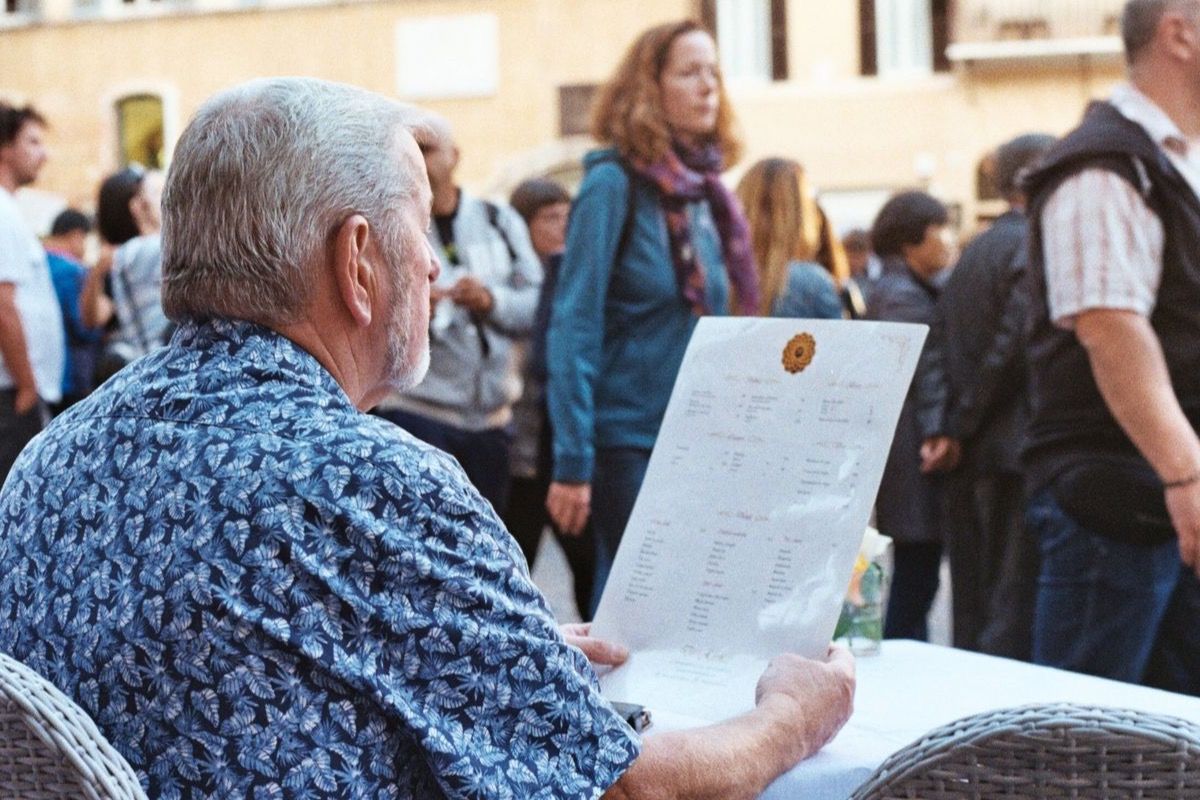
Two summers ago I stood outside a trattoria in Trastevere, reading a menu taped to a wooden stand, understanding about half of it. I cook for a living. I read Italian menus the way other people read traffic signs. And I still stood there for ninety seconds running math I did not want to run — what is in that, what does that cost, what will arrive at the table — before walking two doors down to a place with photographs and an English column.
That decision took less than two minutes and cost the first restaurant a table for four. It had nothing to do with the food. It had everything to do with the cost of decoding.
Now put that scene on your own sidewalk. Saturday, 7:15 p.m., three blocks off the River Walk in San Antonio. A family of five stops at your door. Your host hands them three menus. They spread them out under the awning, and I watch the father’s eyes move down the page and stop. Not at the prices — at the words. Ninety seconds later he smiles at the host, says thank you, folds the menu, and walks his family toward a place with pictures in the window.
Your host clears the menus and seats the next party. Nobody logs the walk-away. There is no complaint card, no one-star review, no row in the POS. Just an empty four-top at 7:40 on a Saturday in the middle of tourist season. I have watched this exact sequence in San Antonio, Nashville, Denver, and the edges of Miami Beach. The owner almost never knows it happened.
The Most Expensive Table in the House Is the One That Never Sits Down
Walk-aways are invisible in every report you run. Cover count only counts the people who stayed. Revenue per available seat only divides by the seats you sold. The guest who left at the door is not a bad number — they are no number at all.
Here is the arithmetic I ask owners to do. Say a family of four turns around at your door twice a week during a 26-week tourist season. At $28 a head, that is $224 a week, roughly $5,800 over the season — from one recurring party, on top of the locals you already serve. If you are near hotels, a convention center, or a landmark, two a week is a conservative estimate.
And that number does not include the second-order loss: the review that never got written, the photo that never got posted, the family that will now default to the chain two blocks away for the rest of their trip because it was easy.
Tourists Don’t Pick the Best Restaurant. They Pick the Easiest One.
A local regular evaluates you on food, service, and whether the corner table is free. A visitor evaluates you on three questions they have to answer in under a minute, standing on a sidewalk, with tired children and a phone at 12% battery: Can I understand this? Can I afford this? Will I embarrass myself ordering it?
You can win the first two and still lose on the third. That is what makes tourist districts so strange: excellent restaurants with full dining rooms two blocks away, and excellent restaurants with empty ones, and nobody able to explain the difference with anything other than “location.”
The United States welcomed 66 million international visitors in 2023, according to the National Travel and Tourism Office. That is 66 million people scanning menus on their phones, looking for a door that feels open. They are not comparing you to the restaurant next door. They are comparing you to every restaurant they have ever eaten in, in a language they speak without thinking.
Why Your Menu Was Never Translated — and Why That Was Rational
I have asked this question in a hundred owner conversations. Why is the menu English-only when a third of Saturday night is international? The answer is almost always the same: “Because we’d have to print one for every language.”
They are not being lazy. They are doing print math. Four languages means four layouts, four rounds of proofing, four print runs, four sets of table cards, and four reprints the week you 86 an item or your beef supplier raises prices. For an independent operator, that math closes at “not worth it.” So nothing gets translated. A few owners do English and Spanish and stop, because the third and fourth languages cost the same as the first two and look smaller on the P&L.
But the premise is wrong. The constraint was never language. It was the substrate. A printed menu is a physical object that has to exist in a specific language before a specific guest walks in. A QR menu is a document that resolves into a language after the guest tells it who they are. Those are not the same product at different prices. They are different products.
The 40% You Are Leaving on the Sidewalk
Tourists spend roughly 40% more per meal than locals, according to Statista. Not because they are careless with money — because vacation money is not grocery money. They order the second cocktail. They order the appetizer they cannot pronounce. They order dessert because they are on a trip, not on a Tuesday.
Now look at what a language barrier suppresses. It suppresses exactly those three decisions: the unfamiliar appetizer, the second drink, the dessert. The items carrying your best margin are the items with names a visitor cannot parse. A menu in the wrong language does not just slow service down. It systematically trims your highest-margin add-ons down to water and the safest entrée.
I watched this in a Korean barbecue house in Los Angeles last spring. A French family of five studied the English menu for eleven minutes and ordered two beef bulgogi, one bibimbap, and water. No drinks, no dessert, no combination. The four-top beside them ordered the full spread, two sides, a soju cocktail, and dessert. Same room, same night. Their check was roughly three times higher. The difference was not appetite. It was comprehension.
Multiply that gap across a season of international visitors and the “small” language stops being small. This is not a marketing problem. It is a pricing problem wearing a translation problem’s clothes.
What Changes When the Menu Speaks First
A QR code that opens in the guest’s own language sounds like a convenience feature. Operationally, it changes four things at once.
First, browse time collapses. Guests stop translating and start choosing. In practice, tables reading in their first language order faster and order more, because they are evaluating dishes instead of decoding nouns.
Second, your staff stop moonlighting as translators. A server’s job is to sell the special and pace the course, not to explain what a word means for the fourth time in a shift. The minutes you save at the table go back into hospitality, which is the part guests actually remember.
Third, the kitchen gets cleaner tickets. A misfire from a language misunderstanding is not just wasted food; it is a wasted seat, a comped plate, and a chaotic Friday at 7:30. Guests who can read the description order what they meant to order.
Fourth, you get information. When you can see which languages actually appear at your tables, you stop guessing at your guest mix. That data changes scheduling, prep, and where you look for a second location.
The One-Week Door Audit
Before you buy anything, spend a week measuring. Put a clipboard at the host stand. Whoever greets tallies the languages they hear — not a survey, not a QR feedback form, just marks on paper, one column per language. Most owners find that the third and fourth languages on the list are not the ones they assumed.
Then count the walk-aways. One tally for parties who looked at the menu and left. Owners who do this for a single week usually stop asking whether translation is worth the money.
Setting It Up Without Printing Anything
One menu, not four. Write your dishes and descriptions once, in your own voice, and let the platform handle the language layer. Keep price in a single source of truth, so a mid-season change updates every language at once instead of triggering a reprint.
Put the QR where the decision happens: the door, the table tent, the host stand, next to the chopsticks. Add four words — “Scan for your language” — and nothing else. Every extra sentence is friction, and the phone already knows what to do.
Train the front of house for five minutes. Show servers the language picker. Show them how to flip a table back to English. Give them one line: if a guest looks stuck, hand them the QR before you hand them a translation.
And keep greeting people. The QR code is not a replacement for hospitality. It is what makes hospitality possible in a language you do not speak.
What the Guest Is Actually Asking
A visitor standing on your sidewalk with a phone in their hand is not browsing. They are asking one question: is this place for me? Your food already answered yes. The menu is the only part still saying no.
qrfood.ai puts your menu in more than 15 languages behind one QR code, updates every language when you change a price, and takes about three minutes to set up. Free to start.
The family that walked away at 7:15 is not gone forever. They are two blocks down, reading photographs in a window. Give them a reason to sit at your table instead.