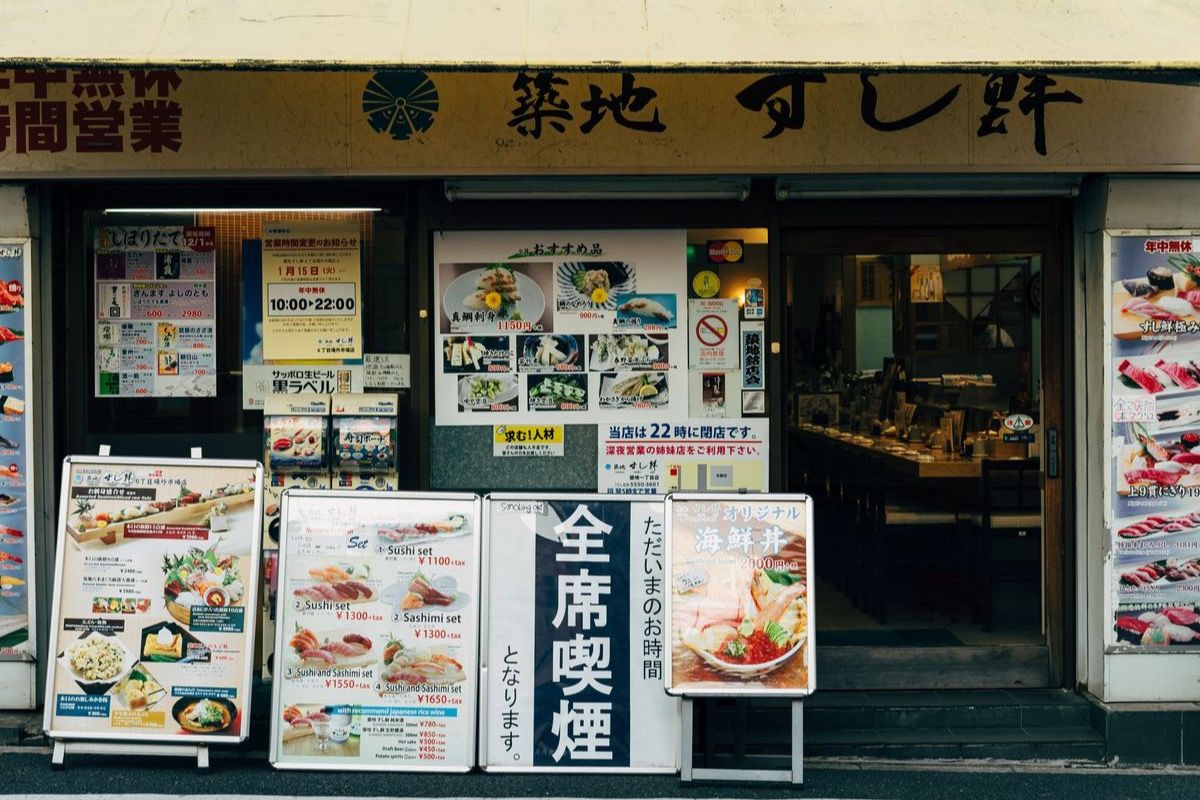
The Fourth Language Problem: What a Tokyo Soba Bar Taught Me About Menu Scaling
It was 6:40 on a Tuesday morning at a standing soba bar inside Shinagawa Station, and the line behind me was already twelve people deep. The shop does one thing: buckwheat noodles, a few toppings, cash or IC card. Four hundred guests pass through its counter before 9 a.m. The entire service window, from eye contact to bowl in hand, is about forty-five seconds.
In front of me stood a Japanese salaryman, a Chinese tour group of six, two Korean business travelers with rolling luggage, and a pair of American backpackers squinting at the wall. The wall was the problem. Four laminated strips, each in a different language, each printed at a different time, each slightly out of date. The Americans were reading the English strip and still pointing at random.
Then I noticed the small square sticker on the counter, next to the chopstick box. No logo, no branding, no explanation. Just a QR code and four words: Scan for your language.
Forty-Five Seconds to Decide
A standing soba bar has no margin for a conversation. There is no table to sit at while you figure things out, no server with time to walk you through the difference between kake and mori. The queue is the product. If one guest takes ninety seconds instead of forty-five, the shop loses a seat-turn it can never recover, because the 7:02 train does not wait.
That is the real reason Japanese convenience food runs on visual systems: ticket machines with photographs, plastic food models in windows, color-coded trays. Not because operators love technology, but because ambiguity is expensive at volume. Every unclear menu item is a pause, and every pause is throughput lost.
The QR sticker was the same logic applied one step further. The guest scans, the phone reports its language, and the menu opens in Japanese, English, Chinese, or Korean without a dropdown, without a flag icon, without asking. Automatic. The sticker exists because the shop could not afford to guess wrong.
What They Actually Built
I asked the owner, between rushes, why he bothered. His answer was not about tourists. It was about the 6:55 express.
"The station sends me people from everywhere," he said. "I do not know who is coming. I cannot print for everyone. So I let the phone decide."
That is the entire design philosophy, and it is the opposite of how most American restaurants approach multilingual menus. Here, we plan for the languages we expect: English, Spanish, maybe Chinese in a neighborhood with a large Chinese community. In Tokyo's busiest transit hubs, the expectation is twelve languages a day, and no operator pretends to know which twelve on any given morning.
The Part American Restaurants Get Wrong
I have had this conversation in Los Angeles, in Austin, in Denver, in Nashville. I ask a restaurant owner why the menu is English-only when a third of their weekend traffic is international, and the answer is almost always the same: "We'd have to print separate menus for every language."
They are right about the arithmetic of paper. Four languages means four layouts, four proofreads, four print runs, four sets of cards to replace every time a price changes or a supplier swaps an item. Most independent restaurants do the math, decide the cost is not worth it, and translate nothing. A few do English and Spanish, then stop. Almost nobody maintains the third and fourth language, because the maintenance burden grows faster than the revenue appears to.
But the premise is wrong. You do not need to print anything. The constraint was never language — it was the format. A QR menu turns four print runs into one translation file and one price list. Update the price once and every language updates with it. That is not a discount on the old method. It is a different method.
The Fourth Language Is the One You Never Planned For
Here is what the paper math misses. The languages you plan for are rarely the ones costing you money. English and Spanish are table stakes in most US markets; you probably already have them covered. The damage happens in the fourth language — Korean, Portuguese, French, Japanese, Arabic — the one you never planned for because the volume looked too small to justify a print run.
I watched this play out at a Korean barbecue restaurant in Los Angeles last spring. A French family of five sat down, worked through the English menu for eleven minutes, and ordered the cheapest recognizable items: two orders of bulgogi, one bibimbap, water. No drinks, no dessert, no barbecue combo. They were not unadventurous. They were managing risk in a language they did not fully control.
The table next to them, four English speakers, ordered the full set: combo platter, two sides, soju cocktails, dessert. Same restaurant, same night, roughly three times the ticket. The difference was not appetite. It was comprehension.
Multiply that gap across a year of international visitors and the "small" language stops looking small. It is not a marketing problem; it is a pricing problem hiding inside a translation problem.
What Auto-Detection Actually Changes
Auto-detection sounds like a convenience feature. Operationally, it changes four things at once.
First, browsing time collapses. Guests stop translating and start choosing. In practice, tables that read a menu in their own language order faster and order more items, because they are evaluating dishes instead of decoding nouns.
Second, staff stop being translators. Your server's job is to sell the special and time the courses, not to explain what "mentaiko" means for the fourth time in a shift. Every minute saved at the table goes back into hospitality, which is the part guests actually remember.
Third, tickets get cleaner. Misorders from language confusion are not just wasted food; they are wasted covers, comped plates, and kitchen chaos at 7:30 on a Friday. A guest who can read the description orders what they meant to order.
Fourth, you learn something. When you can see which languages are actually being served at your tables, you stop guessing about your guest mix. That data changes how you staff, what you stock, and which neighborhood you consider for the second location.
How to Run This Play in Your Restaurant
You do not need a Tokyo station. You need a menu that stops requiring a translator.
Start with an audit. For one week, have your hosts note the languages they hear at the door. Not a survey, not a guest questionnaire — just a tally on a clipboard. Most owners are surprised by the third and fourth language on the list.
Then build one menu, not four. Enter your dishes and descriptions once, in your own words, and let the platform handle the language layer. Keep prices in a single source of truth so a mid-season price change does not require reprinting anything.
Then put the QR code where the decision happens: at the door, on the table tent, on the counter by the chopsticks. Add four words — "Scan for your language" — and nothing else. Every extra instruction is friction; the phone already knows what to do.
Finally, train the floor for five minutes. Show your servers the language picker, show them how to switch a table back to English, and tell them the one line that matters: "If a guest looks stuck, offer the QR code before you offer a translation."
The Standard Tokyo Already Set
The soba bar owner in Shinagawa is not running a technology company. He is running a forty-five-second business in a station that never stops moving, and he solved a problem most American restaurants still treat as unsolvable. Not with more paper, not with more staff, not with a bigger menu. With a link that speaks first.
If a standing counter with six seats and a ten-item menu can serve the world in its own language, the barrier for a full-service restaurant with a patio and a wine list is not technology. It is habit.
QRfood.ai gives you that same behavior in about three minutes: one QR code, automatic language detection across 15+ languages, and a single place to update prices and descriptions. No print runs, no laminated strips, no guessing which language your next table speaks.
The next guest at your door is already holding the answer. Let the menu meet them there.