The "Translate This" Moment: How a DC Ethiopian Restaurant Closed 60% More Walk-Ins
Washington, DC has the largest Ethiopian community outside of Ethiopia. U Street, Shaw, and the stretch of 9th Street NW known as Little Ethiopia are packed with injera houses serving wat, tibs, and kitfo. The foot traffic is heavy — but it skews overwhelmingly Ethiopian.
And the non-Ethiopian crowd? They walk past. Or worse: they walk in, look at the menu, and walk right back out.
Eight to Ten Groups a Day — Gone
I sat down with Mulu, who runs a busy 9th Street spot that's a favorite of DC's Ethiopian community.
"Non-Ethiopian customers would walk in, look at the menu, then walk out. Every day. Maybe 8 to 10 groups," she told me. "It got to the point where I could predict it. I'd see them at the door and think, 'They're not staying.'"
She did the math. With an average ticket of $35–40 and roughly eight lost groups a day, that's somewhere between $3,000 and $5,000 in unearned revenue every single month. Not because the food wasn't good. Because it was unfamiliar.
The Barrier Wasn't the Food. It Was the Vocabulary.
Ethiopian cuisine carries a specific vocabulary that means everything to a regular and nothing to a first-timer.
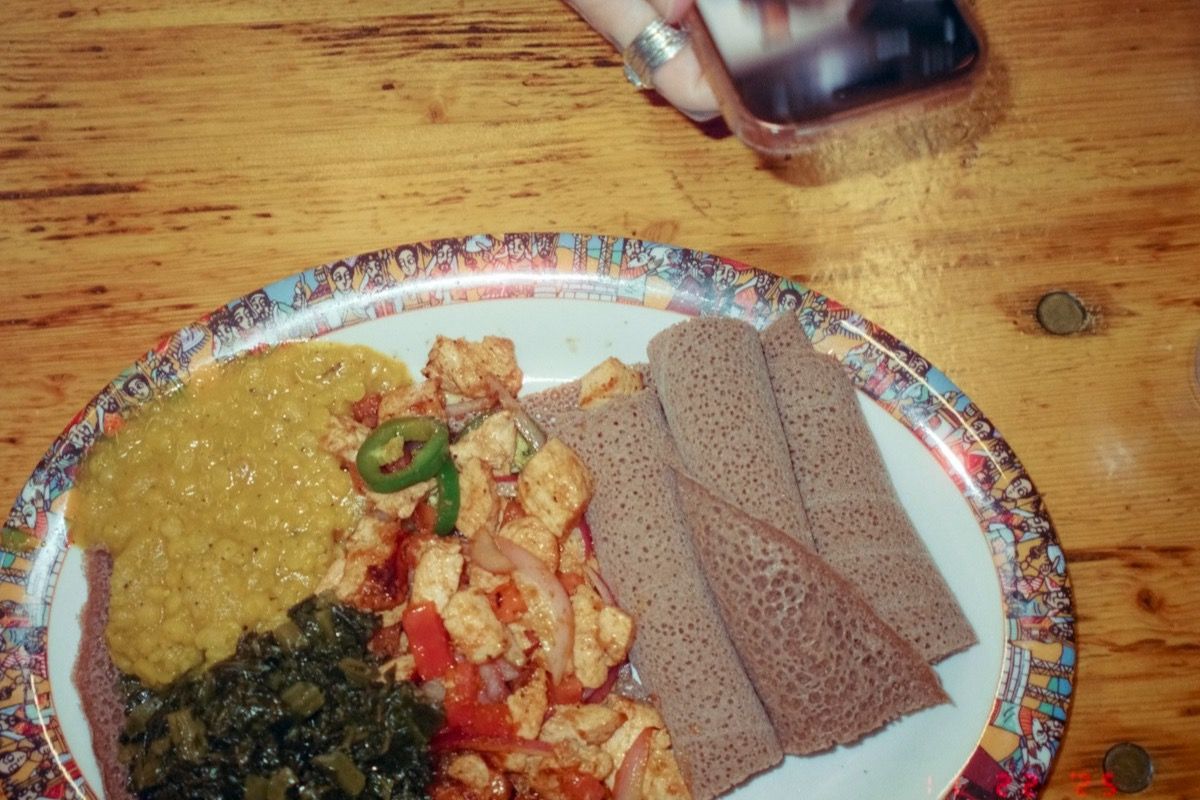
"Doro Wat" means nothing to someone from Bethesda. "Kitfo" sounds like a dare. "Injera" looks like a sponge and behaves like a utensil. The menu carried Amharic names on the left and English names on the right — but zero descriptions.
So customers didn't know what they'd be eating, how spicy it would be, or how to order it. Was it family-style or individual plates? Do you eat it with a fork? Is there a vegetarian option? Every unanswered question was a reason to leave.
Three Columns. That's the Whole Fix.
Mulu rebuilt her menu as a digital, scannable menu with three simple columns:
• Amharic name — for the regulars who already know and love it.
• English name — so anyone can see it says "chicken."
• A two-line description — what it is, what it tastes like, and what to pair it with.
Her example: "Doro Wat — spicy chicken stew, slow-cooked with berbere spice, served with injera." That's it. Fourteen words that turn an unfamiliar name into a decision.
No reprinting. No laminated menus. Customers scan a QR code at the table — or at the window — read in a language they know, and order with confidence.
The Result: 30% to 78%
Within two months, Mulu's walk-in conversion — the share of people who walk through the door and actually sit down and order — climbed from roughly 30% to 78%.
But the conversion number was only half of it. The new customers ordered bigger tickets. They shared plates. They asked follow-up questions about the spices instead of backing away. And they took photos for Instagram — free marketing she never had to pay for.
"The food never changed," she said. "What changed is that people finally understood what they were ordering."
Why This Works Anywhere, Not Just in DC
Replace Ethiopian with any cuisine that has a vocabulary gap: Vietnamese, Sichuan, Japanese, Korean, regional Mexican, Indian. The pattern holds everywhere we look.
A 30%–40% walk-in conversion rate is normal for an unfamiliar cuisine with an unexplained menu. Close the explanation gap and every market we've tracked lands in the 60%–80% range. The unknown is the tax. Descriptions are the refund.
The Real Cost of "We'll Just Explain It at the Table"
Plenty of owners think they can solve this with staff. But a two-line description works 100% of the time, for 100% of customers, in 10+ languages — without hiring a bilingual server or repeating yourself forty times a night.
And that's before you count the customers who never get that far. The ones who look at an all-Amharic menu and leave before anyone can explain anything. Staff can't fix a customer who already walked out.
What QRfood Does
This is exactly what QRfood is built for. One QR code. A complete digital menu in 10+ languages. Photos, descriptions, allergen notes, and prices — for every dish, not just the ones you have time to explain.
Your berbere spice blend doesn't scare customers. The unknown does. Remove the unknown, and they'll eat it up.
Mulu's menu didn't get simpler. It got clearer. And clearer is what converts.
Give Every Customer the Confidence to Try Something New
If your menu makes people feel like an outsider, no amount of great cooking will bring them back. If it makes them feel like an insider, they'll bring their friends.
Start free at qrfood.ai. Add the three columns. Watch what happens to the people who used to walk out.