Fine Dining Has Waiters, Not Order-Takers. QR Ordering Gives Them Their Time Back.
On a Tuesday at 7:40 PM in Boston's North End, the room is full. White tablecloths, candles, a four-page wine list, and an $85 average check. The floor team is five people who have worked this room for years. The captain knows the regular at table 11 takes his amaro before dessert. He knows which couple is celebrating an anniversary and which one is having a hard conversation.
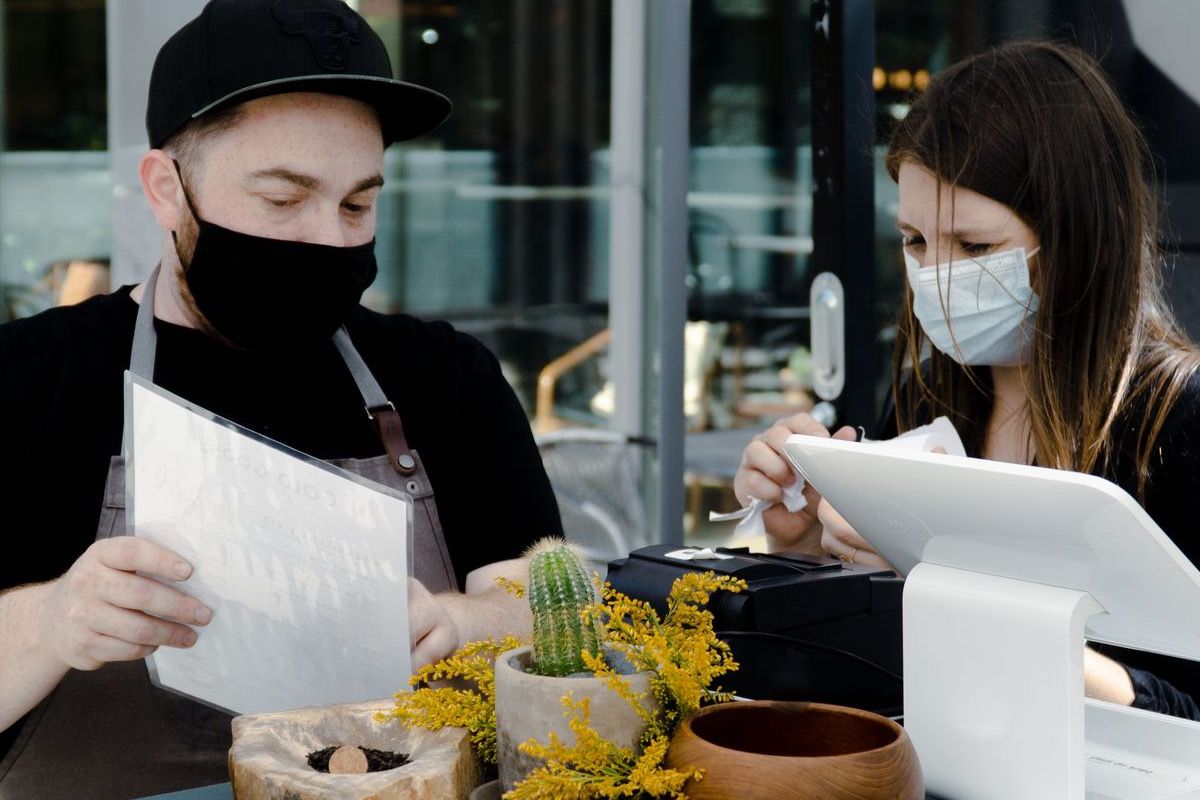
He also knows — because I asked him to time it for a week — that he spends roughly 108 minutes of every six-hour shift standing at a POS terminal. Typing in orders. Firing courses. Splitting checks four ways. Running cards back and forth to a machine near the service bar.
That is 30% of a career professional's evening spent on data entry, in a restaurant whose entire product is human attention.
Fine dining does not have a staffing problem. It has a time allocation problem. And most operators try to solve it with the wrong tool — hiring another body, or cutting hours — when the real answer is to stop asking your best people to do work a phone can do.
The Arithmetic of a Six-Hour Shift
Here is the math we ran across four fine dining rooms last quarter, with servers self-timing their terminal minutes over five shifts each:
• Average six-hour shift at the POS: roughly 1.8 hours (30%)
• Same shift with guest-ordered, guest-paid QR: roughly 0.3 hours
• Time recovered per server per shift: about 1.5 hours
Now put that on a five-server floor. That is 7.5 labor hours returned to the dining room every single night — the equivalent of a sixth server, at no additional payroll cost.
The number that surprises owners is not the 1.5 hours. It is where those hours go when nobody assigns them. Left alone, recovered time gets absorbed by sidework and standing around. Deliberately reassigned, it becomes the thing guests actually pay $85 for.
What 1.5 Hours Actually Buys
In a fine dining room, the difference between a good night and a great one is usually one more touch per table. Not a faster kitchen. Not a bigger menu. One more moment of attention.
Reinvest 90 minutes per server into the floor and it looks like this: a real wine recommendation instead of a safe one, because the server had time to taste the new Sicilian red; a dessert upsell that lands because it was offered at the right moment, not shouted from across the room; a second visit to the four-top that has been quiet for twenty minutes; a table that gets re-crumbed before the guest notices.
None of that shows up in a labor report. All of it shows up in the review, the rebooking, and the tip line.
The Upselling Effect Nobody Budgets For
Servers who spend more of their shift selling — and less doing data entry — move the average check. Across our sample, rooms that shifted order entry and payment to guest devices saw average check rise 8-15%.
At an $85 check, that is $6.80 to $12.75 per table. Four tables per server per shift: $27 to $51 per server, per shift. Annualized over 250 shifts, that is $6,750 to $12,750 per server — and on a five-server floor, $33,750 to $63,750 a year.
That is not a technology ROI slide. That is a compensation conversation you can finally afford to have, and a retention lever in a market where experienced servers are the scarcest asset in the building.
What Fine Dining Guests Actually Want
Let me be direct, because this is where most QR pitches go wrong: fine dining guests are not looking for a robot experience. They are paying for a knowledgeable human who makes the evening feel like it was arranged for them.
QR ordering should handle the mechanical parts — order entry, modifiers, allergen detail, split checks, payment — and get out of the way for everything else. It should not narrate the tasting menu. It should not pour the wine. It should not decide that this table wants to be rushed and that one wants to sit for three hours.
The rule I give every operator: the technology should be invisible at the moments that matter, and automatic at the moments that do not.
Where QR Belongs in a White-Tablecloth Room — and Where It Does Not
Yes, use it for:
• Beverage and second-round orders once the first course is down. This is the single biggest terminal-time sink in fine dining, and the least romantic.
• Dessert and after-dinner drinks, offered at the table with the phone already in the guest's hand.
• Check delivery and payment. The guest pays when they are ready, not when a server walks past with a card reader.
• Allergen and dietary detail, read at the guest's own pace instead of a rushed conversation over a loud room.
• Retail and takeaway — the olive oil, the sauce, the pastry box — which most rooms lose simply because nobody has time to ask.
No, do not use it for:
• The tasting menu narrative, the wine pairing, the story behind a dish. That is the product.
• Anything that requires reading a table's mood. A phone cannot tell that a guest wants to be left alone.
Think of QR ordering in fine dining as removing the pencil, not the person.
The Rollout That Does Not Break the Room
Phase one: payment only. Put the QR on the check presenter. The guest pays at the table, the server stops running cards, and your team experiences the benefit before anyone asks them to change how they take an order. This phase alone recovers a surprising share of the 1.8 hours.
Phase two: beverage and dessert add-ons. Low risk, high margin, and it teaches guests that the phone in their hand is part of the service rather than a replacement for it.
Phase three: full order-at-table, offered — never mandated. Some guests will want it every visit. Some will want to talk to a person every visit. Both are correct, and a good room accommodates both without making either feel like a downgrade.
One rule for the whole rollout: never announce "we now have QR ordering." Train the team to offer it as a service — "if you'd like to order the next round yourself, it's right here" — not to enforce it as a policy.
The Objection I Hear From Every Owner
"Our guests expect a server." They do. That is exactly the point. What they do not expect is to watch that server hunt for a terminal during the entrée, or disappear for six minutes to split a check three ways.
"Our POS already does tableside." Then you are paying for a device per table and still doing the data entry yourself. Handheld terminals moved the keypad; they did not remove it.
"Won't it feel transactional?" Only if you deploy it transactionally. A QR code that says "pay here" feels like a kiosk. A QR code that says "here is the amaro list, and here is the Barolo we opened tonight" feels like a good restaurant.
What to Measure in the First 60 Days
Time it, do not guess it:
• Minutes at the terminal per server per shift (target: under 25 minutes)
• Average check (target: +8% within 60 days)
• Covers per server, same labor hours
• Check-to-payment time (target: under 6 minutes)
• Guest comments that mention pace of service, read weekly
• Server intent to stay, asked directly at day 60
If average check is flat and terminal minutes are flat, you did not change the workflow — you added a screen.
The Bottom Line
Fine dining is the last place where labor cost should be solved by cutting people. The people are the product. What you can cut is the clerical work wrapped around them: the typing, the splitting, the card runs, the walk to the terminal and back.
Restaurants that make this shift keep their payroll flat, lift revenue 8-15%, and — the part nobody puts in a deck — keep the captain who knows what table 11 drinks.
QRfood was built for exactly this: guest ordering and payment that runs on the guest's phone, a menu you update in minutes, and a kitchen and floor that see the same ticket at the same time. No new hardware per table, no per-location fees, and support that answers in English, Chinese, and Japanese.
Try it on one section of your floor for 30 days. Time the terminal minutes before and after. The number will make the argument for you.
Your guests came for the evening, not for the keypad.